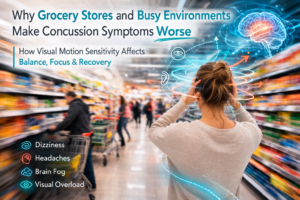
Why Grocery Stores and Busy Environments Make Concussion Symptoms Worse
Many people recovering from a concussion notice that certain environments suddenly become overwhelming. One of the most common triggers patients describe is walking into a grocery store, mall, or busy classroom.
For individuals with persistent concussion symptoms, these environments can quickly provoke dizziness, headaches, or brain fog. The reason for this is not simply light sensitivity — it is often related to how the brain processes visual motion.
The Brain’s Balance System
Your brain constantly integrates information from three major systems to maintain balance and spatial awareness:
• The visual system – what your eyes see
• The vestibular system – balance organs in the inner ear
• Proprioception – signals from muscles and joints that tell the brain where the body is in space
When these systems work together smoothly, you can move through busy environments without difficulty.
After a concussion, however, communication between these systems can become less efficient.
Why Grocery Stores Are So Difficult
Grocery stores contain large amounts of visual information moving in multiple directions:
• Long rows of repeating patterns on shelves
• People walking in different directions
• Bright lighting
• Moving carts
• Changing visual depth cues
For a brain that is still recovering from a concussion, processing this level of visual motion can overload the system.
This sensory overload often leads to symptoms such as:
• Dizziness
• Head pressure
• Difficulty concentrating
• Visual fatigue
• Increased headaches
• Feeling disoriented
This condition is commonly referred to as visual motion sensitivity.
Why Symptoms Can Persist
Many individuals are told to simply rest after a concussion. While rest is important in the early stages, persistent symptoms often require targeted rehabilitation.
If the brain avoids challenging environments completely, it may not properly retrain the sensory pathways needed to process motion and visual input.
Over time this can cause symptoms to persist.
How Treatment Can Help
Rehabilitation programs for persistent concussion symptoms often focus on restoring coordination between the brain’s sensory systems.
Treatment may include exercises designed to:
• Improve eye movement control
• Reduce visual motion sensitivity
• Improve balance and spatial awareness
• Retrain coordination between visual and vestibular systems
• Increase tolerance to visually busy environments
As these systems improve, patients often notice that environments like grocery stores become much easier to tolerate.
When to Seek an Assessment
If dizziness, headaches, or sensory overload continue weeks or months after a concussion, a comprehensive neurological and vestibular evaluation may help identify the underlying cause.
Understanding which systems are contributing to symptoms allows treatment to be more targeted and effective.
Concussion Treatment in Markham
At our clinic, we focus on identifying and treating the root causes of persistent concussion symptoms, including dizziness, visual motion sensitivity, and cognitive fatigue.
Treatment programs are individualized and may include vestibular therapy, visual rehabilitation, and neurological exercises designed to restore normal sensory integration.
Book an Assessment
If you or your child are experiencing ongoing concussion symptoms, including dizziness or difficulty in busy environments, an assessment may help determine the next steps in recovery.