
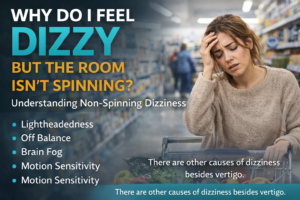
Why Do I Feel Dizzy But the Room Isn’t Spinning?
Many people think dizziness always means the room is spinning.
That spinning sensation is called vertigo, and it is often caused by conditions like BPPV (Benign Paroxysmal Positional Vertigo).
However, many people experience dizziness without the spinning feeling.
Instead, they describe symptoms like:
-
Feeling lightheaded
-
Feeling off balance
-
Feeling disoriented or “foggy”
-
Feeling like they might faint
-
Feeling unstable when walking
-
Feeling overwhelmed in busy environments
This type of dizziness is actually very common, and it often comes from how the brain processes balance information.
The Brain’s Balance System
Your sense of balance depends on three major systems working together:
1. The Inner Ear (Vestibular System)
Your inner ear detects head movement and acceleration.
It tells your brain when your head moves and helps keep you stable.
2. Vision
Your eyes help your brain understand where you are in space.
They also work with the vestibular system to keep your vision stable when your head moves.
3. Body Awareness (Proprioception)
Your muscles and joints constantly send signals to the brain about your body position.
This helps you maintain balance when standing and walking.
Why You Can Feel Dizzy Without Vertigo
When these systems aren’t working together properly, the brain receives conflicting information.
This mismatch can cause symptoms such as:
-
Lightheadedness
-
Brain fog
-
Motion sensitivity
-
Feeling off balance
-
Difficulty focusing
This is often referred to as sensory integration dysfunction of the balance system.
Common Causes of Non-Spinning Dizziness
Several conditions can cause dizziness without vertigo.
Vestibular Dysfunction
Sometimes the inner ear balance system becomes irritated or weakened.
This can lead to symptoms such as:
-
Feeling off balance
-
Motion sensitivity
-
Difficulty in busy environments
-
Feeling worse when walking in crowds
Autonomic Nervous System Dysfunction
The autonomic nervous system regulates things like:
-
Blood pressure
-
Heart rate
-
Circulation to the brain
If this system becomes dysregulated, people may feel:
-
Lightheaded when standing
-
Fatigue
-
Brain fog
-
Dizziness without spinning
Visual-Vestibular Mismatch
Many people experience dizziness in places such as:
-
Grocery stores
-
Shopping malls
-
Busy streets
-
Large crowds
This occurs because the brain becomes overwhelmed by too much visual motion, leading to dizziness.
Persistent Postural-Perceptual Dizziness (PPPD)
PPPD is a condition where the brain becomes overly sensitive to motion and balance signals.
Symptoms often include:
-
Chronic dizziness
-
Feeling off balance when walking
-
Sensitivity to busy visual environments
-
Feeling worse when standing for long periods
Why Imaging Often Looks Normal
One of the frustrating parts of chronic dizziness is that MRI and CT scans often appear normal.
This is because these scans look for structural problems, not how the brain processes sensory information.
Dizziness is often caused by functional disruptions in the balance network, which require specialized testing to identify.
Assessment for Chronic Dizziness
A comprehensive dizziness evaluation may include:
-
Eye movement testing
-
Vestibular reflex assessment
-
Balance testing
-
Visual-vestibular integration testing
-
Autonomic nervous system screening
These tests help identify which part of the balance system is not functioning properly.
Treatment for Non-Spinning Dizziness
The brain has an incredible ability to adapt and retrain balance networks.
Treatment often focuses on:
Vestibular Rehabilitation
Specific exercises designed to retrain the brain’s balance system.
Visual-Vestibular Training
Exercises that improve how the eyes and inner ear communicate.
Balance Training
Exercises that strengthen the brain’s ability to integrate sensory information.
When Should You Seek Help?
You should consider an evaluation if you experience:
-
Dizziness lasting more than two weeks
-
Feeling off balance when walking
-
Sensitivity to busy environments
-
Lightheadedness when standing
-
Chronic motion sensitivity
These symptoms often improve when the underlying balance dysfunction is properly identified and treated.
Assessment and Treatment of Dizziness
Dr. Jordan Bennett provides assessment and treatment for patients experiencing dizziness, vertigo, and balance disorders.
As a Doctor of Chiropractic and Diplomate in Clinical Neuroscience, Dr. Bennett performs detailed neurological and vestibular examinations to determine which part of the balance system may be contributing to symptoms.
Assessment may include evaluation of:
-
Eye movements
-
Vestibular reflexes
-
Balance and postural control
-
Sensory integration
-
Autonomic nervous system function
Treatment programs are designed to retrain the brain’s balance networks using targeted neurological rehabilitation and vestibular exercises.
Final Thoughts
Dizziness without spinning can be confusing and frustrating, especially when standard tests appear normal.
In many cases, the problem lies in how the brain integrates balance signals, not in structural damage.
With the right assessment and rehabilitation approach, many people can significantly improve their symptoms and return to normal activities.