
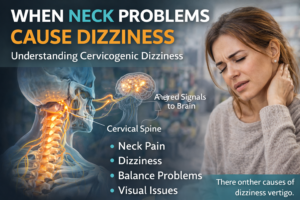
Can Neck Problems Cause Dizziness?
Most people think dizziness comes from the inner ear or the brain, but the neck plays a critical role in the body’s balance system.
The upper cervical spine contains thousands of specialized sensory receptors that constantly send information to the brain about head position, movement, and posture.
These signals help the brain coordinate:
-
Balance
-
Eye movements
-
Posture
-
Spatial awareness
When the neck is injured or not functioning properly, these signals can become distorted or mismatched, which can create symptoms such as dizziness and imbalance.
This condition is commonly referred to as cervicogenic dizziness.
How the Neck Communicates With the Brain’s Balance System
Your brain maintains balance by integrating information from three major systems:
1. The Inner Ear (Vestibular System)
The inner ear detects head movement and acceleration.
2. Vision
Your eyes help your brain understand where you are in space.
3. The Neck and Body (Proprioception)
Sensors in the muscles and joints of the neck provide constant information about head position relative to the body.
These three systems must work together seamlessly.
When the signals from one system become abnormal — such as from the cervical spine after injury — the brain receives conflicting information, which can lead to dizziness.
Why Cervical Spine Dysfunction Often Happens After Concussion
Many concussions occur during events that also place stress on the neck, including:
-
Sports injuries
-
Car accidents
-
Falls
-
Whiplash-type movements
During these injuries the head experiences rapid acceleration and deceleration, which affects both the brain and the cervical spine.
Because of this, dizziness after concussion can come from multiple sources:
-
Brain network disruption
-
Vestibular (inner ear) dysfunction
-
Cervical spine dysfunction
In many cases, the neck becomes an important but overlooked contributor to persistent dizziness.
Symptoms of Cervicogenic Dizziness
People with cervicogenic dizziness often describe:
• Dizziness that worsens with neck movement
• Neck stiffness or tension
• Headaches at the base of the skull
• Feeling off balance when walking with increased head motion
• Difficulty focusing or concentrating
• Recreation of dizziness by compressing certain neck muscles
Unlike vertigo conditions such as BPPV, cervicogenic dizziness usually does not cause spinning sensations.
Instead, people often describe feeling unsteady, disoriented, or ‘on a boat’
Why Cervicogenic Dizziness Can Be Difficult to Identify
One of the challenges with cervicogenic dizziness is that medical imaging often appears normal.
MRI and CT scans are designed to detect structural problems such as:
-
fractures
-
bleeding
-
tumors
However, cervicogenic dizziness often involves altered sensory signaling between the neck and the brain, which cannot be seen on imaging tests.
Because of this, proper diagnosis requires a detailed clinical assessment of the balance system.
Assessment of Cervicogenic Dizziness
A comprehensive evaluation may include assessment of:
-
Cervical spine mobility and function
-
Neck muscle coordination
-
Joint position sense (proprioception)
-
Eye movement control
-
Vestibular reflexes
-
Balance and postural stability
Evaluating how the neck interacts with the brain’s balance system helps identify whether cervical dysfunction is contributing to symptoms.
Treatment for Cervicogenic Dizziness
The brain has an incredible ability to adapt and retrain sensory networks.
Treatment often focuses on restoring normal communication between the neck, vestibular system, and brain.
Rehabilitation strategies may include:
Cervical Spine Rehabilitation
Improving mobility, strength, and control of the neck.
Sensorimotor Retraining
Exercises that retrain the brain to accurately interpret signals from the neck.
Vestibular Rehabilitation
Exercises that improve how the brain processes balance information.
Eye–Head Coordination Training
Improving the interaction between eye movements and head movements.
When to Seek Help
You may benefit from an evaluation if you experience:
-
Persistent dizziness after concussion or whiplash
-
Neck pain associated with dizziness
-
Feeling off balance when turning your head
-
Headaches originating from the neck
-
Difficulty focusing or visual instability
These symptoms may indicate that the cervical spine is contributing to balance dysfunction.
Assessment and Treatment of Cervicogenic Dizziness
Dr. Jordan Bennett provides assessment and treatment for patients experiencing dizziness related to cervical spine dysfunction, concussion, and vestibular disorders.
As a Doctor of Chiropractic and Diplomate in Clinical Neuroscience, Dr. Bennett performs detailed neurological and vestibular examinations to determine whether dizziness may be related to cervical spine dysfunction, inner ear disorders, or brain network changes following concussion.
Assessment may include evaluation of:
-
Cervical spine mobility and joint function
-
Eye movements and vestibular reflexes
-
Balance and postural control
-
Sensory integration between the neck, vestibular system, and brain
Treatment programs are designed to restore communication between the cervical spine and the brain’s balance networks using targeted neurological and vestibular rehabilitation strategies.
Final Thoughts
Dizziness can arise from many different parts of the body’s balance system.
In some cases, dysfunction of the cervical spine plays an important role in disrupting how the brain processes balance signals, particularly after concussion or whiplash injuries.
Understanding how the neck, inner ear, and brain work together allows for more targeted treatment approaches and improved recovery.