
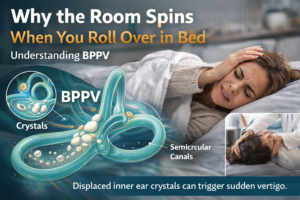
Why the Room Spins When You Roll Over in Bed: Understanding BPPV
If you’ve ever rolled over in bed, looked up, or bent down and suddenly felt like the entire room was spinning, you may have experienced a condition called BPPV (Benign Paroxysmal Positional Vertigo).
Despite the long name, BPPV is actually one of the most common and treatable causes of dizziness and vertigo.
Many people suffer from this condition for weeks or months simply because they don’t know what it is — or that it can often be corrected quickly with the right treatment.
What is BPPV?
BPPV occurs when tiny calcium crystals inside the inner ear become displaced.
Inside your inner ear are structures called the semicircular canals, which help your brain detect head movement and maintain balance.
These canals contain fluid and sensory cells that tell your brain when your head moves.
Sometimes small crystals (called otoconia) that normally sit in another part of the inner ear become loose and drift into one of these canals.
When that happens:
-
Head movements move the crystals
-
The fluid in the canal shifts abnormally
-
The brain receives incorrect motion signals
This mismatch between the inner ear, eyes, and brain creates the sensation that the room is spinning.
Common Symptoms of BPPV
People with BPPV often describe:
• Sudden spinning sensation when rolling in bed
• Vertigo when looking up or bending down
• Dizziness lasting 10–30 seconds
• Nausea during episodes
• Feeling off balance afterward
Many people say it feels like:
“The room suddenly spins when I move my head.”
Episodes typically occur during:
-
Getting into or out of bed
-
Rolling over
-
Looking up at a shelf
-
Bending forward
The Good News: BPPV is Often Treatable
One of the most encouraging things about BPPV is that it is often highly treatable with specific repositioning maneuvers.
These treatments work by moving the displaced crystals out of the semicircular canal and back to where they belong.
Common treatments include:
• Epley maneuver
• Semont maneuver
• Barbecue roll maneuver (for horizontal canal BPPV)
When performed correctly, many patients experience rapid improvement.
Why Proper Diagnosis Matters
Not all dizziness is BPPV.
Because dizziness can come from many different systems in the body — including the inner ear, brain, vision, and balance systems — it is important to properly identify the cause.
A thorough examination typically includes:
• Positional testing (Dix-Hallpike test)
• Eye movement testing
• Balance assessment
• Vestibular function evaluation
This helps determine:
-
Which ear is involved
-
Which canal contains the crystals
-
Which maneuver will correct the problem
Assessment and Treatment of BPPV
Dr. Jordan Bennett is trained in the assessment and treatment of benign paroxysmal positional vertigo (BPPV) and other vestibular disorders.
As a Doctor of Chiropractic and Diplomate in Clinical Neuroscience, Dr. Bennett performs detailed vestibular examinations to determine whether dizziness is caused by BPPV or another balance disorder.
The assessment may include:
• Dix–Hallpike positional testing
• Eye movement and nystagmus analysis
• Vestibular and balance system evaluation
• Identification of the specific canal involved
Once the source of vertigo is identified, treatment may involve specific canal repositioning maneuvers such as the Epley maneuver, Semont maneuver, or Barbecue roll, depending on the type of BPPV present.
These treatments are designed to guide displaced inner ear crystals back to their proper location, which often results in significant improvement in symptoms.
Dr. Bennett focuses on evidence-based vestibular rehabilitation and neurological assessment to help patients restore balance and safely return to normal daily activities.
When to Seek Help
You should consider an evaluation if you experience:
• Repeated spinning sensations
• Vertigo when rolling in bed
• Dizziness triggered by head movement
• Ongoing balance problems
The right assessment can often identify the cause and guide effective treatment.
Final Thoughts
BPPV may feel frightening when it happens, but in many cases it is a mechanical problem in the inner ear that can be corrected with targeted treatment.
If you experience spinning sensations when moving your head, a proper vestibular evaluation can help determine whether BPPV is the cause and what steps can help restore your balance.